
CW121
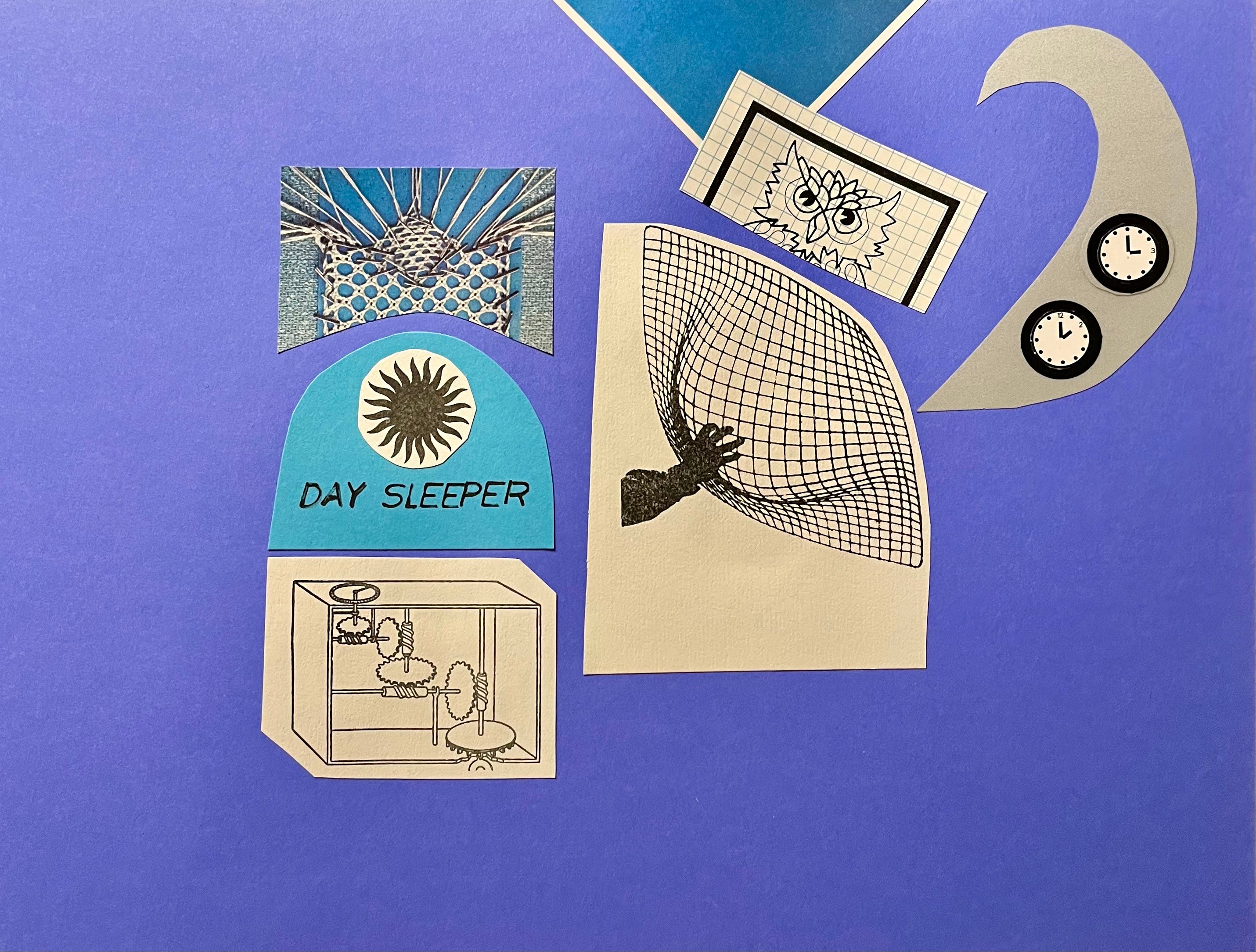
Ever since I had a choice, I’ve been a night owl. I have a theory of how it works. I like to keep doing whatever I’m doing as long as I can. That means I like to stay up very late. Once I’m sleeping, I don’t want to get up. If you like to push whatever you’re doing further and further, your sleep schedule gets “turned around.”
But there are also theories that a night owl isn’t turned around at all. We are wired to be that way. From an evolutionary standpoint, it makes sense to spread out when people are naturally awake. A whole group of sleeping humans makes them vulnerable. Because I am asleep, I am hopeless to alert my group that there’s trouble at 10 a.m. But I’m good to go at 3 in the morning, sharp and glinting in the firelight.
Night owls don’t live as long as morning people. Some scientists think that this is because what night owls are doing is unhealthy. Other scientists think that what’s unhealthy is being a night owl living in a society calibrated to the morning people. Let’s flip it around. If you are a morning person, imagine this: you have a dentist appointment at 2 a.m. again. It’s the only time you can get in. It’s the “normal” time.
I am writing this in Connecticut, at a family thing. It is 12:48 p.m. and I’ve been awake for under an hour. My partner was going to get me up at 11, but then let me sleep till noon. (This was a conversation. I’m really good at going back to sleep. Being woken up is not an issue for me.) She was nice enough to bring me coffee. I am in a transition where I am hoping to acquire the ability to become social. Everyone downstairs has been awake for hours. I could’ve easily slept till 3 p.m.
I am fascinated by the tendency of musicians to be night owls. An easy explanation is that music work is often night work, so the profession attracts the night owls. Or the musicians just get on the schedule their job demands. But a lot of music work isn’t night work. For example, from 1996 to 2020 I made most of my living teaching lessons. Those hours are mostly after-school and after-work hours: roughly 2 p.m. to 8 p.m. They don’t account for how late I was going to sleep and getting up.
I’d like to believe that the connection between music and night owls is something deeper. Night people are outsiders. We are part of society, but we live on the margins, tuning in to different frequencies. The small hours are a “thin place”: the spirit world is closer by. Music is a thin place too. It seems to operate as a conduit between this realm and another.
I’ve changed over the years in some fundamental ways. I no longer drink alcohol or smoke weed. (I quit tobacco very young: in 1995 at age 19.) In December I’ll have ten years sober, God willing. I’ve even been off sweets since May. But I still drink a lot of coffee. And I am still a night owl.
I love sunlight, but too much of it upsets me. When I have to get up early (say 7 or 8), noontime, especially a sunny one, fills me with a particular horror. I want to jump in in medias res, a day already dramatically rushing toward the big change of night. On the other end, I hate to see the dawn. That’s where I’ve gone too far. I’m happy pushing toward that edge, but miserable falling off it. Seeing both sides of night seems to suggest daylight has the upper hand.
Some people outgrow being a night owl. Maybe they had kids so they had to. I chose not to have kids. But I have friends who didn’t have kids who are morning people now. It strikes me as kind of cool, but also completely impossible. Just thinking about it makes me feel ill.
I have one living grandparent: Meemaw. She is my mom’s mother. She turned 100 in November. She stays up late reading and gets up around 10 or 11. She sleeps a lot more hours than most people her age.
That’s also true of me. I’m not just a night owl. I’m a prolific sleeper. More like ten hours a night than eight. And three or four times a month I sleep twelve to fourteen hours in one go. Tell them my secret was sleep.
I wrote about a chord in “Day Sleeper” last week. That post is behind a paywall, so I’ll repeat the song details here for those of you who don’t go behind the curtain: “Day Sleeper” was written in Austin, Texas, in 2003, and recorded in New Haven, Connecticut, in April 2005. It was originally on a 2005 CD-R called April Demos. Now it can be found on my Bandcamp on Billy Don’t Pawn Your Horn.
I remember seeing a bumper sticker in Austin that said Day Sleeper. I wrote the song not long after.
“Day Sleeper”

It’s two or three o’clock in the afternoon
I couldn’t keep the dreams from ruin
Must we whistle morning’s tune?

The mask among the trees on my bathroom wall
Seems to justify my scrawl
Those twinkling eyes have known this kind of fall

The geese are going soon to the opera house
Home of holey roof and mouse
The moon is in the angel’s mouth
Your world is north but we go south
“I couldn’t keep the dreams from ruin”:
You sleep in as long as possible, but eventually the dreamworld won’t hold itself together anymore. It falls apart, so you give up and get up.
“The mask among the trees on my bathroom wall”:
For much of my twenties, I had a picture cut out of a Japanese book that I hung in a series of apartment bathrooms. It was a photograph of a tiled roof in a forest—taken from above?—and an ancient, weatherworn stone face, peaking out through the leaves. I don’t remember the composition of the elements, but I remember the feeling. It was blue and moody. In Austin, it was to the right of the mirror. I’d look at it when I was brushing my teeth. (Why “mask” for that stone face? I’m seeing the “mirror” just above here too and making connections. I like how a flaw or a lapse can present as a clue.)
“Those twinkling eyes have known this kind of fall”:
Falling outside the bounds of society. But the eyes of the stone face glitter and laugh at that. They recognize me, people like me. We lose pace with one measure of achievement while reaching for something more difficult. Not everyone will understand, but this guy does. Forget 2003. This hammock is tied wide. Those are centuries down there.
“Home of holey roof”:
The holey roof is also holy. The image is of geese flying south to inhabit a grand, abandoned opera house. It’s a wrecked, rotting place, open to the elements, that provides sanctuary for various creatures.
The word “ruin” in the first stanza connects to the photograph of a Japanese ruin (or at least something very old) in the second stanza, and now the third stanza also has a kind of ruin.
“The moon is in the angel’s mouth”:
The ceiling of this opera house is decorated with a mural. There is a hole where an angel’s mouth used to be, and you can see the moon through it.
“Your world is north but we go south”:
By 2003, I was finding a rhythm down in Texas. I knew I belonged back in New England, and that I would be leaving for home that summer, but I finally—it took a few years—understood the charm of the South. The narcotic heat, the molasses pace, the novelty (for me) of a counterculture with a drawl. I knew it was time to go, but I could’ve dreamt down there for longer.
And sleep is a kind of “south,” while awake is sort of “north.”
Like so many of my songs, this one is a slippery play of opposites. And what’s a wreck from one point of view sometimes floats very well from another. Floats right off.
In short, I like to sleep in. 💕