
CW117
I’m tempted to say Bob Weir is the member of the Grateful Dead I’m temperamentally the least like, but really I was never even close to anything like any of those guys. I may fancy myself a musical risk-taker, but that doesn’t put me in their league. They were outlaws; they were freaking crazy! (Maybe I’m a little like Phil Lesh.)
I’m nothing like him, but Bob Weir is my favorite.
To me, he is harsh in all these funny ways. He is like a fluorescent, undulating Laffy Taffy. He is yelling, nearly barking. He keeps fit, wears the polo shirt, seems to identify as a hot guy.
And yet, as he focuses to sing, his eyes look crazy, glassy, gone. Whatever shit he’s into—the cowboy songs, 70s material goopy with jazz-chord shampoo—fundamentally: this is a very strange person. He’s a true original in a band of true originals.
(Here’s how you can tell the Grateful Dead are actually nonconformists: They don’t conform to each other either.)
Bob freaking Weir. His name is almost Weird. (It also starts off like my last name, which I admit I’m into.) He’s over the top, hilarious, and he drives me wild.
Many of my favorite Grateful Dead songs are Weir songs:
“Jack Straw”
“Lazy Lightning”: I love the studio Kingfish version too. (“Supplication” is cool, but has less of the ice cream roller-coaster feeling, for me anyway, than the song that leads into it.) When he’s singing about the “loop of lazy lightning” I get a Shaggy from Scooby-Doo feeling I find funny and also soothing.
“Black-Throated Wind”: The rhythms of the chorus confuse me in a way I always love. I want to learn to play this song. It has a beautiful pre-chorus too. A powerful and sad American highway feeling for me.
“Playing in the Band”: My favorite Grateful Dead jam vehicle. So many different ways—like gears spinning behind the sky—of phrasing the 10/4 meter. “I don’t trust to nothing / But I know it come out right” has talismanic force for me. (Robert Hunter, rather than Weir’s usual lyricist John Perry Barlow, wrote the lyrics to this one.) It also features the Donna Scream at the end of that one section. That’s Donna Jean Godchaux, who just passed in November. I love Donna Jean, and I love that Scream. It’s like the Wilhelm Scream (if you don’t know, look it up) to me: the more of them there are, the merrier I am. My mother’s first and middle name are also Donna Jean, and that’s what my dad’s always called her, so the Donna Jean in the Grateful Dead has always been like a weird dream. Jesse Jarnow, the brilliant writer and Dead expert, told me in an email the other day that it was Bob Weir who first started calling her that. If you want to get a good feeling about Weir, listen to Donna Jean talk about “Bobby.” Their musical chemistry and friendship is another thing I love about him.
“Lost Sailor” / “Saint of Circumstance”: Maybe going on a feeling! The whole trip through both these songs is my favorite Grateful Dead right now. Some of it sounds like Michael Hedges or something, like the Windham Hill music I came up listening to. It is musically very rich. There’s mostly this one video from 10/31/80 that I watch. “Sure don’t know what I’m going for / But I’m gonna go for it for sure”—there it is.
“Estimated Prophet”: Another Bob Weir odd meter exploration (this one in 7). The “California!” B section, which is suddenly in bright G (mixolydian) instead of F# minor (“Rising up to paradise”), gets me every time. (There are a bunch of common tones between those keys, but the coolest to me is the E# (TI) in F# minor (E (TE) also appears) being kept on as the F (TE) in G—glinting, like being winked at.) It’s on Terrapin Station. I have a personal connection to this one. My friend Blake Mills is the current leaseholder (along with Tony Berg) of Sound City in Van Nuys, California. What was originally a Vox factory became a recording studio in 1969. Blake currently has Studio A and Tony has Studio B. Insanely important music was recorded in both. I spent a bunch of time at Sound City in 2022 and 2023. In 2022 Blake and I were recording his album Jelly Road there. When I wasn’t standing where Bob Dylan had recently sang Rough and Rowdy Ways, or deeply spooked that this was the room Kurt Cobain sang “Smells Like Teen Spirit” in, etc., etc., I was thinking about the Dead making Terrapin Station in there. Producer Keith Olsen made the Grateful Dead practice their music way more than they usually did before recording, and they did that in A. Overdubs were done in other studios, but all the initial work was done at Sound City. One could argue that all that practicing had a positive effect on the famous Spring 77 tour that followed their time making this album. (“Fire on the Mountain,” though it wasn’t on Terrapin, was apparently worked out at Sound City—there’s a tape of them playing it in A (2/17/77). (They debuted the song live on 3/18/77, and it showed up on their next non-compilation album: Shakedown Street.) That’s the Dead song I have the deepest and oldest relationship to. It really weirds me out thinking about it being worked out in there.) Recording Jelly Road with Blake is probably the hardest I’ve ever worked on music—before I met Blake, I’d never met anyone I couldn’t outwork. It’s strange that’s the same room where the Dead were pushed to work harder than usual too.
“France”: This is an odd choice, but I love the fucked-up feeling of this song. Bobby and Donna sing it together. It’s on Shakedown Street with “Fire” and also “From the Heart of Me”: a song sung and written by Donna Jean that I first heard while watching The Closing of Winterland. “From the Heart of Me” is another unconventional Dead song to focus on, but I absolutely love it. The intro sounds like Phish.
“Looks Like Rain”: My favorite version is from Dick’s Picks 9 (9/16/90), but I always love “Looks Like Rain.” (I love it on Weir’s 1972 “solo” album Ace too—it’s crazy how many important songs are from that album (including “Black-Throated Wind” and “Playing in the Band”).) I want to focus on a note. It’s not always this way, but it often is (and it is on 9/16/90). He sings the word “gone” (it’s that word the first time it happens), pushing it up a semitone against a beautiful chord change. I’m focused on how he tunes the first half. It’s like he hears where he’s about to go and something about it makes him sing flat. On 9/16/90 you can hear him start normal but then push it down to where he wants it. Yes, it can sound a little comic, “off-key.” But it can also sound somehow more in tune.
That note captures something I love about the Dead, something I aspire to: true commitment. This music is not about the individuals coming off as polished, skilled, smart, any of that stuff. This group is willing to risk embarrassment and disorder for the greater good of reaching, expansion, transcendence. Weir’s eyes get that look because there’s something he hears that he’s locked in tight trying to trace.
I also love the Bob Weir stuff I hate. His cover of “El Paso” sometimes seems to be around every bend, a desert of uptempo waiting. I’ve come to respect myself for not skipping it. It’s like a realm of hell you’ll be stronger from if you manage to get through it. I don’t take drugs, so I mean this metaphorically, but: “El Paso” deepens the trip. It’s like the sharp spikes of the peyote cactus. (Or would be—I just looked it up—if the peyote cactus had spikes. You get the idea.)
Weir is sometimes a lot (as the kids say), but that flavor is essential to the whole, to the health of the overall organism.
The overall: That’s the thing about the Grateful Dead. Unconstricted individuals somehow flower more fully with a purpose that is higher than individual expression. I don’t know if that’s a paradox, or the right amount of friction. I picture crickets rubbing their wings together to sing, to send their signals. But the cricket is the band, and the musicians are the wings: rough stuff together finding purchase, new dimensions.
Like his friend Jerry, like all of them, Bob Weir seemed to genuinely understand it wasn’t about him. There was some trap they all snapped loose of. And that made them very free, at least in glimpses. How sustained those glimpses often were, and how intelligible and contagious they remain—that might be their most radical accomplishment.
To be honest, the song I’ve chosen for today only vaguely relates to Bob Weir. I more just want to keep the rhythm of theory-week-followed-by-lyric-week going. But then why did I think of it right away?
“Troublemakers” is on I Hope You’re Enjoying Scotland (2023), an album that begins with a song explicitly about the Grateful Dead (though they go unnamed in the lyrics): “The Slow Version.” (See CW59.)
Maybe the two protagonists of “Troublemakers” remind me of Jerry and Weir. Whoever they are, they seem to be part of something countercultural, maybe not legal? “Troublemakers” is a little like a Steely Dan song that way: it’s in code you don’t know, but you can tell something dangerous and wild is probably afoot.
In any case, when I read Jesse Jarnow’s remembrance of Bob Weir on Pitchfork the other night, I took the appearance of the word “troublemaker” early on as a green light.
But really today’s Cadential Windfall is just a chance to write about my favorite freak from the Grateful Dead—RIP Bob—and post the lyrics to pretty much a random song I just happen to like. Let them jangle. They’re all keys to the same door. 💕
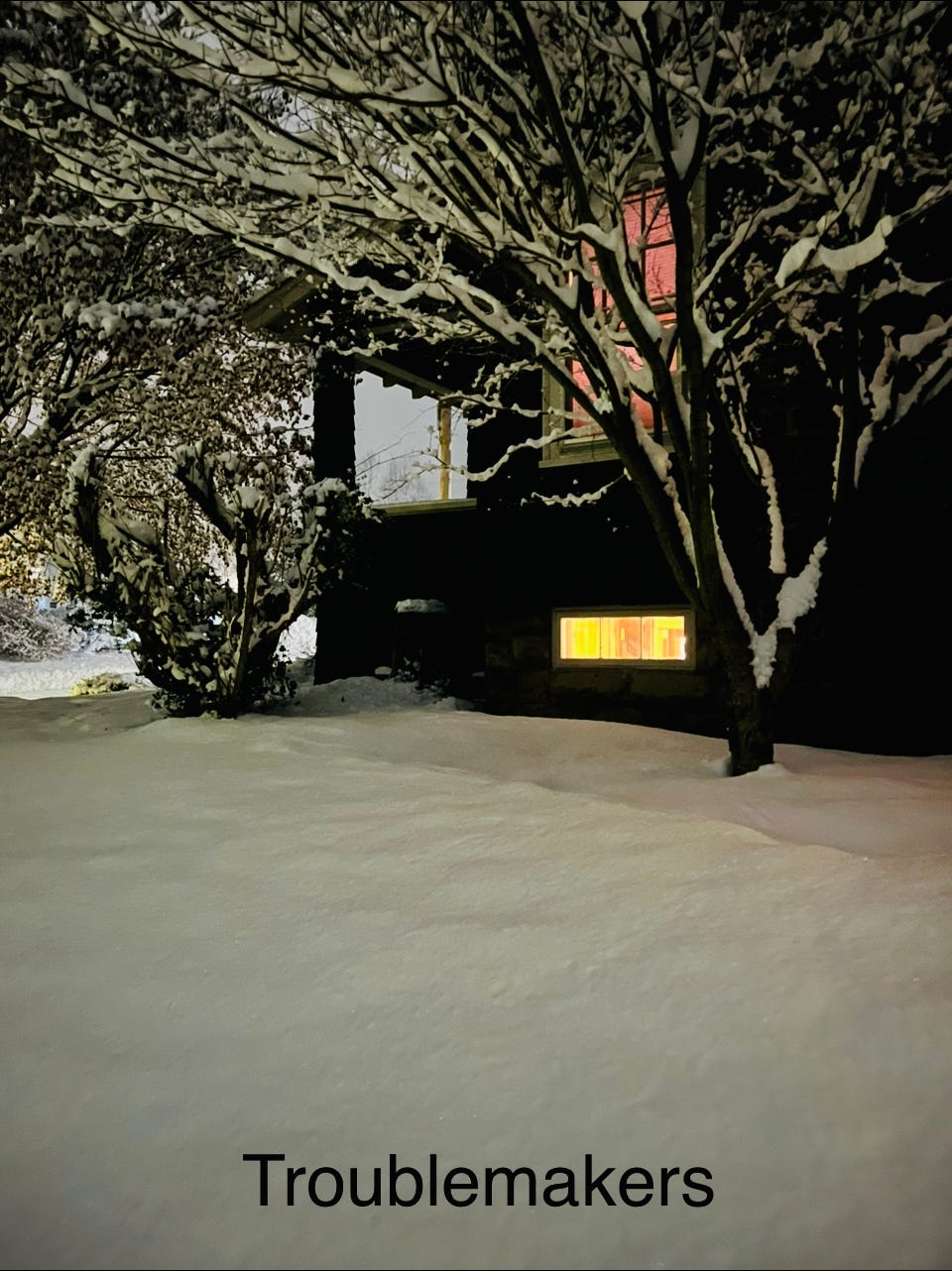
“Troublemakers”

Robin’s Egg Blue
And Seafoam Green
Everything else
Was just the scene
But these ones were the characters

Robin’s Egg
And Seafoam night
Characters
Demand the lights
But these two get no playtime

That wouldn’t be the angel’s hair
That wouldn’t be the strummed
That wouldn’t be so dumbed down for the masses
Uh-huh

These top-notch good-for-nothing troublemakers
Hiding back in there
At least for some of it

Robin’s Egg trouble
And Seafoam too
Everyone else was blasted in the beach house
But these guys have no truck

Robin’s Egg cold
And Seafoam ice
Everyone else had flown down South
But luckily you’re in luck

That wouldn’t be the angel’s hair
That wouldn’t be the strummed
That wouldn’t be so dumbed down for the masses
Uh-huh

These top-notch good-for-nothing troublemakers
Hiding back in there
At least for some of it
PS Leave Greenland Alone 🇬🇱